

The Complete Guide to Topsoil in Connecticut
The complete Connecticut topsoil guide. What real topsoil is, what’s commonly sold as topsoil but isn’t, how Connecticut’s native soils shape what you actually need, the science behind a good blend, and how to pick the right product for lawns, gardens, planting, and grading. Written from the perspective of a Milford yard that has produced, screened, and delivered topsoil and compost across Connecticut since 1993 — including CT DOT-approved material for the Merritt Parkway expansion.
What Topsoil Actually Is (and What Most People Are Sold)
Topsoil is the uppermost layer of soil — typically the top 2 to 8 inches of a natural soil profile — where organic matter, microbial life, and plant root activity concentrate. That’s the textbook definition. In practice, almost everything sold as “topsoil” in Connecticut is something else.
Most of what gets trucked around the state under the topsoil label is subsoil — material excavated from below the organic-rich top layer during construction, grading, or site clearing. It’s similar in appearance to real topsoil, especially once it’s been sitting in a pile, but the organic content is wrong, the biology is dead, and grass seed planted into it tends not to come up.
This isn’t a technicality. The difference between topsoil and subsoil is the difference between a lawn that establishes and a lawn that fails. The reason real topsoil is harder to find is that producing it requires actual work — sourcing native loam, composting organic material, screening, blending, curing — while construction subsoil costs nothing because it’s a byproduct of clearing land.
Grillo Services has produced its own topsoil at the Milford facility since 1993 specifically because of this gap. Our screened topsoil is a blend of native Connecticut farm loam and organic leaf compost, screened to ½”, with approximately 12% organic content. It’s CT DOT approved and tested — the same material the State of Connecticut accepted for the Merritt Parkway expansion (20,000 cubic yards through O&G Industries) and that Pallazzo Associates used for the Pound Ridge Country Club build (35,000 yards of our Eco Soil variant). Central Park has also sourced topsoil from our Milford yard.
The shortcut for telling real topsoil from subsoil: Real topsoil is dark — visibly dark, not just damp-brown — because organic matter is dark. Subsoil tends to be lighter brown, tan, or even reddish depending on the parent material. If a pile looks pale and dry, it’s probably not topsoil regardless of what the invoice says.
The Connecticut Soil Reality
Connecticut’s native soils were shaped by glaciation. The last ice sheet ground across New England, stripped most of the older soil profile, and left behind a layer of glacial till — a mix of rocks, sand, silt, and clay deposited as the ice retreated roughly 12,000 years ago. That history is why Connecticut soils are notoriously rocky, why drainage varies wildly across short distances, and why almost every major landscape or construction project in the state involves importing soil.
Coastal Connecticut (Fairfield County coast, New Haven, southeast shore)
Sandier loams, lower organic content, decent drainage, generally acidic. The soils along the Long Island Sound corridor drain well but often need organic matter and structure added. Most estate-scale properties in towns like Greenwich, Darien, and Westport were graded heavily during construction and the original topsoil is long gone — what’s left is a thin layer over compacted subsoil and fill that needs to be capped with quality screened topsoil before any landscape work can succeed.
Central Connecticut Valley
Heavier clay-loam soils with poorer drainage and higher fertility. The Connecticut River corridor was historically prime agricultural land for exactly this reason. Topsoil work here is less about adding fertility and more about improving structure and drainage.
Western and Northeastern Hill Country
Rocky, shallow soils over till and bedrock. Litchfield County, the northwest corner, and the eastern uplands tend to have thin native soil with significant stone content. Major landscape work here almost always involves imported material in volume because the native soil isn’t workable in volume.
What this means in practice: there’s no statewide answer to “how much topsoil do I need.” The real question is what your native soil looks like and what you’re trying to grow on top of it. A new home in Greenwich and a renovation in Litchfield are going to have very different soil starting points, even if the project on the surface looks identical.
Soil Science Primer: What Makes a Topsoil Work
A good topsoil is the right combination of mineral texture, organic matter, biological activity, pH, and structure. None of these traits show up in a casual look at a pile. The pile tells you about color and screen size. Everything that matters for plant growth is invisible without testing.
The Soil Texture Triangle
Mineral soil is built from three particle sizes: sand (the largest, gritty), silt (medium, floury), and clay (the smallest, sticky when wet). The proportions of these three particles define a soil’s texture class. The USDA soil texture triangle is the standard reference. Below is a simplified version showing where the major texture classes sit, followed by the percentage ranges that define each one.
USDA Soil Texture Triangle. Loam — at the center — is the balance most plants prefer.
The triangle is a visual reference. The table below shows the actual percentage ranges that define each major texture class — useful when you have lab results and want to know what you’re working with.
| Texture Class | % Sand | % Silt | % Clay | General Character |
|---|---|---|---|---|
| Sand | 85–100 | 0–15 | 0–10 | Drains fast, holds little water or nutrients |
| Loamy Sand | 70–90 | 0–30 | 0–15 | Sandy with slight body; still drains quickly |
| Sandy Loam | 43–85 | 0–50 | 0–20 | Workable, decent drainage, moderate fertility |
| Loam | 23–52 | 28–50 | 7–27 | Balanced — the ideal for most plants |
| Silt Loam | 0–50 | 50–88 | 0–27 | Smooth, holds moisture well, can compact |
| Silt | 0–20 | 80–100 | 0–12 | Floury, fertile, drains poorly |
| Clay Loam | 20–45 | 15–53 | 27–40 | Heavier, holds nutrients, drainage varies |
| Sandy Clay Loam | 45–80 | 0–28 | 20–35 | Sandy but with enough clay to bind |
| Silty Clay Loam | 0–20 | 40–73 | 27–40 | Smooth and clay-heavy, sticky when wet |
| Sandy Clay | 45–65 | 0–20 | 35–55 | Uncommon; gritty and heavy |
| Silty Clay | 0–20 | 40–60 | 40–60 | Very sticky, drains poorly |
| Clay | 0–45 | 0–40 | 40–100 | Holds everything, drains nothing, hard to work |
Sand particles are large (0.05–2 mm), gritty, and have lots of pore space between them. Sandy soils drain fast, warm quickly in spring, and don’t hold nutrients well. Silt (0.002–0.05 mm) feels floury when dry and slick when wet. Silt holds moisture and nutrients better than sand but compacts easily. Clay (under 0.002 mm) is sticky when wet and rock-hard when dry. Clay holds the most water and nutrients but drains poorly and is hard to work.
The sweet spot is loam — roughly 40% sand, 40% silt, 20% clay — which combines drainage, moisture retention, and nutrient holding capacity. Connecticut farm loam, the base of our screened topsoil, sits in this range. That’s not an accident. The native loam was selected specifically because it’s what plants want.
Organic Matter — The 3 to 5 Percent Window
Organic matter is decomposed plant and animal material — leaves, roots, microbes — that has broken down into a dark, spongy substance called humus. It’s the biological component of soil. Most healthy natural topsoils contain 3 to 5 percent organic matter by weight. Native Connecticut farmland often runs in this range.
Our screened topsoil runs around 12 percent organic matter because it’s blended with leaf compost. That’s significantly above natural topsoil and well above what generic construction-source “topsoil” provides. The reason for blending up is simple: most of the projects topsoil gets used for — new lawn installs, garden beds, planting work — benefit from more organic matter than nature would put there. The compost component adds nutrients, improves water-holding capacity, supports microbial activity, and gives the soil its dark color.
Organic matter percentages worth knowing:
| Material Type | Typical Organic Matter % | Use |
|---|---|---|
| Subsoil / construction fill | Under 1% | Structural fill only — not for growing |
| Native Connecticut topsoil | 3–5% | Baseline for farmland and undisturbed sites |
| Grillo Screened Topsoil | ~12% | Lawn installs, grading, finish work |
| Grillo Garden Mix (50/50) | ~25–30% | Raised beds, vegetable gardens, planting |
| Pure organic compost | 50%+ | Amendment — mix into existing soil, not standalone |
Cation Exchange Capacity (CEC)
CEC measures a soil’s ability to hold and release nutrients to plant roots. Without getting into the chemistry: clay particles and organic matter both have negatively charged surfaces, and nutrient cations (calcium, magnesium, potassium, ammonium) bind to those surfaces and stay available to plants. Sand has almost no CEC, which is why pure sand doesn’t grow much. Clay has high CEC. Organic matter has very high CEC.
A loam-based topsoil blended with compost — the structure of our screened topsoil — gets meaningful CEC from both the clay fraction and the organic matter. This is why amended loam outperforms either pure sand or pure clay for almost every growing application: it actually holds onto the nutrients you add through fertilizer or that the compost contributes.
pH and Connecticut’s Acidity Problem
Most native Connecticut soils run acidic — pH 5.0 to 5.5 is common, sometimes lower in heavily forested or coniferous areas. The acidity comes from decades of acid rain, leaching of base cations by rainfall, and the natural chemistry of New England’s parent material.
The problem is that most lawn grasses, vegetables, and ornamental plants prefer a pH between 6.0 and 7.0. Below that range, nutrients become less available even when present in the soil, and aluminum toxicity can become an issue. This is why lime is the most-applied amendment in Connecticut — it raises pH back toward where plants can use the nutrients in the soil.
A quality topsoil should be in the 6.0 to 7.0 range coming in, which is one of the things to ask about when sourcing. Our screened topsoil is in this range, and for major commercial or institutional projects we can provide current lab results on request — contact the contractor channel for spec material requests.
Soil Structure vs. Soil Texture
These get confused constantly. Texture is the sand/silt/clay ratio — it doesn’t change. Structure is how those particles aggregate together into clumps, crumbs, blocks, or plates. Structure is what determines whether water and roots can move through the soil, and unlike texture, structure can be destroyed (compaction) or built up (organic matter additions, biological activity, proper handling).
A well-structured loam crumbles in your hand into small aggregates. A compacted or structureless soil comes apart in solid chunks or won’t crumble at all. Heavy equipment driving on wet soil, repeated tillage, and pure construction subsoil all destroy structure. Good handling, organic matter additions, and avoiding wet-soil traffic preserve and rebuild it.
Screened vs. Unscreened — What ½” Really Means
Screening is the process of running soil over a vibrating mesh that separates out rocks, roots, clumps, and oversized debris. The mesh size determines how fine the finished product is.
| Screen Size | What Gets Through | Best For |
|---|---|---|
| ¼” | Very fine soil, sand-like consistency | Topdressing, golf course work, precision finishing |
| ⅜” | Fine soil with small aggregates | Premium lawn and sod prep, garden beds |
| ½” | Smooth soil with small aggregates and pebbles | General screened topsoil, lawn installs, grading, planting |
| ¾” – 1″ | Coarser material with larger stones | Backfill, rough grading, base work |
| Unscreened | Everything from fines to rocks and roots | Fill, structural use only, not for growing |
We screen our topsoil to ½”, which is the practical standard for landscape and lawn work. Tighter screens (⅜” or ¼”) cost more to produce per yard and slow down material flow, which is why they’re typically priced higher or reserved for specialty work like our golf course divot mix. For 95% of residential and commercial lawn, garden, and grading work, ½” screened is the right specification.
The Full Grillo Soil Taxonomy
What we actually produce and stock, what each product is, and which job it’s for. Every soil on this page is screened, blended, and delivered from our Milford yard — not brokered, not resold, not sourced from an unknown pile. Browse the full soil and compost catalog or pick by product below.
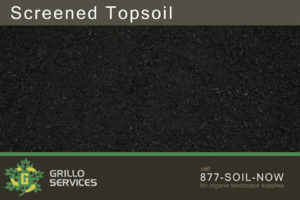
Screened Topsoil
The all-purpose product. Native Connecticut farm loam blended with organic leaf compost, screened to ½”. CT DOT approved and tested. Approximately 12% organic content. Dark, rich, easy to rake and grade.
Use it for: New lawn installs, sod prep, seed prep, finish grading, leveling, filling low spots, planting bed construction, tree and shrub planting, general soil improvement.
Single yard for typical residential projects, or 20-yard tri-axle bulk for lawn installs over ~3,000 sq ft, contractor jobs, and estate-scale work.
Screened Compost
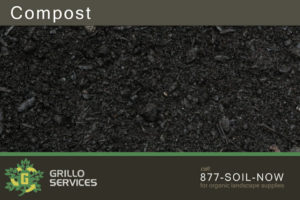
Pure amendment, not standalone soil. Produced at our CT DEEP permitted facility from locally collected leaves and clean yard waste. Aerobically composted, cured, and screened to ½”. No sewage sludge, no municipal solid waste — just decomposed organic material.
Use it for: Amending existing soil, building organic matter in vegetable gardens, mulching planting beds, topdressing lawns. Not a substitute for topsoil — compost is an amendment, meant to be mixed with mineral soil at roughly 25–30% of total volume for most applications.
Single yard for garden amendment and small lawn projects, or 20-yard bulk for farm-scale and commercial amendment work.
Organic Garden Mix
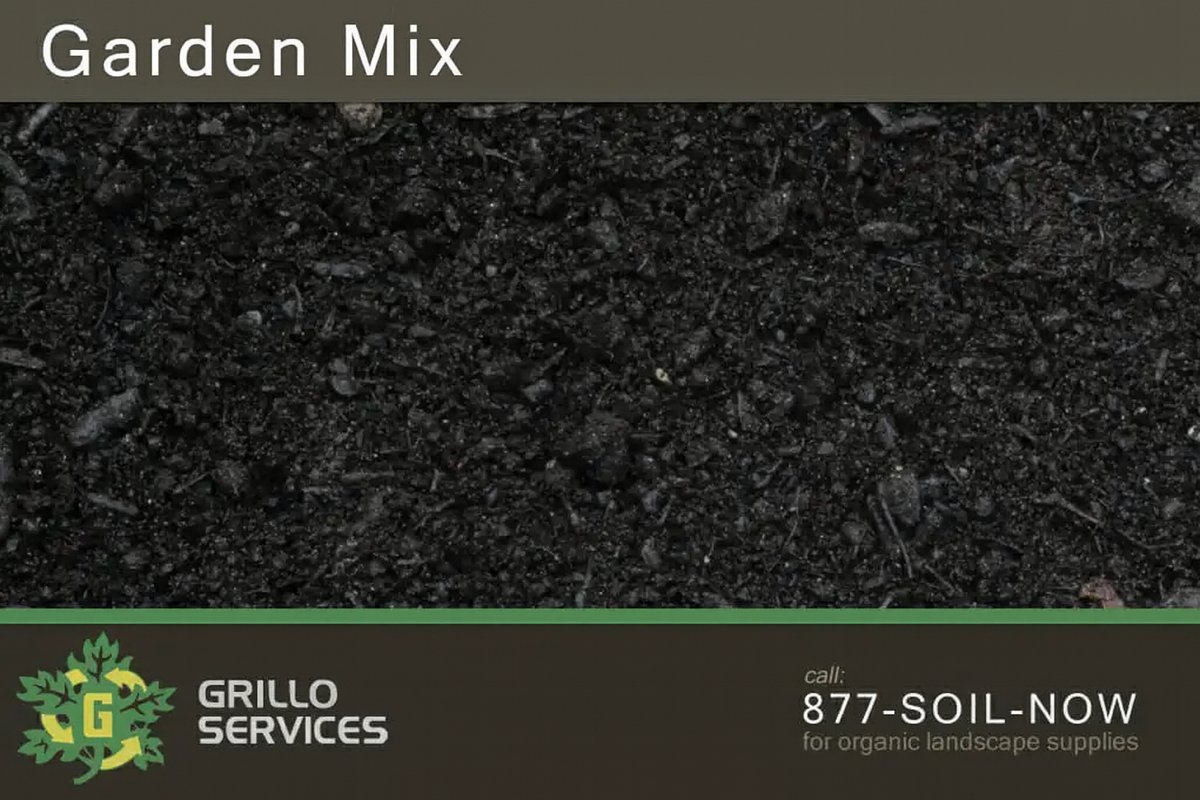
Ready-to-plant growing medium. A 50/50 blend of our screened topsoil and organic compost, with 9-0-5 slow-release organic fertilizer blended in. This is what you want when you don’t want to buy and mix the components separately.
Use it for: Raised beds, vegetable gardens, flower beds, herb gardens, any planting area where you want the richest growing conditions out of the pile.
Single yard for typical raised beds and garden projects, or 20-yard bulk for large raised bed projects, community gardens, and commercial planting installs.
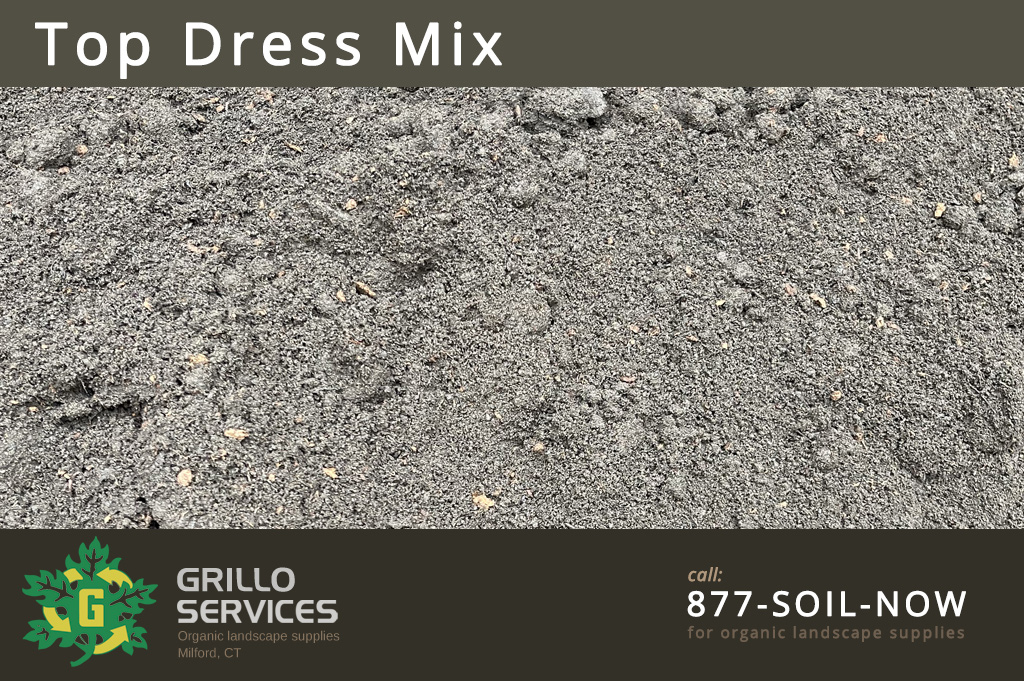
Top Dress Mix (Lawn Mix)
Custom turf blend. 4 parts screened topsoil, 3 parts coarse sand, 1 part peat moss. The sand improves drainage and reduces compaction. The peat regulates moisture. The topsoil provides nutrients and a smooth finish.
Use it for: Lawn topdressing after aeration, overseeding prep, leveling minor low spots in established lawns, turf renovation, ongoing lawn maintenance. Spreads smooth and settles into existing turf without smothering grass. For new sod installs, our standard screened topsoil is what we recommend — top dress mix is for working over and around existing turf, not under new sod.
Eco Soil
Planting-grade blend with more stone content. Same general makeup as our screened topsoil — farm loam plus leaf compost — but with a higher small-stone content. Used by Pallazzo Associates for the Pound Ridge Country Club project (35,000 yards).
Use it for: Tree and shrub planting, ornamental beds, large-scale planting work. The added stone content improves drainage in planting pits and around root balls. Not recommended for lawn installs — for turf surfaces you want the cleaner finish of standard screened topsoil. Eco Soil is a contractor and large-volume product — call (203) 877-5070 or visit contractor info for pricing and availability.
Fill — Clean and Screened
Structural material, not for growing. Bulk material for raising grades, building pads, backfilling foundations, and any application where soil quality doesn’t matter but volume does. Screened Fill is run through a 5/8″ screen for a more workable finish. Clean Fill (Fill Dirt With Rocks) contains rocks and debris — expected, not a defect.
Use it for: Raising lot grades, building up around structures, filling large excavations, base material under topsoil. Plan to cap with screened topsoil if anything will grow on the surface.


For large-volume contractor pricing, call (203) 877-5070.
Which Product for Which Job — Decision Matrix
| Project | Recommended Product | Why |
|---|---|---|
| New lawn from seed | Screened Topsoil | Smooth finish, proper organic content, supports germination |
| New sod install | Screened Topsoil | Same — clean finish, root contact, no debris |
| Lawn topdressing | Top Dress Mix | Sand and peat in the blend won’t smother existing grass |
| Raised vegetable bed | Garden Mix | Ready to plant — topsoil, compost, and fertilizer pre-mixed |
| Flower bed (new) | Garden Mix or Screened Topsoil | Garden Mix if planting immediately, topsoil if amending later |
| Tree / shrub planting | Eco Soil or Screened Topsoil | Eco Soil drains better in planting pits; topsoil for general use |
| Filling low spots in lawn | Screened Topsoil | Rakes smooth, grows grass |
| Raising lot grade (structural) | Fill, cap with Topsoil | Fill for volume, topsoil for the growing layer |
| Amending existing garden soil | Organic Compost | Pure organic amendment, mix into native soil |
| Grading / drainage correction | Screened Topsoil | Holds grade, smooth finish, supports re-establishment |
How Much Topsoil Do You Need?
The formula is straightforward:
(Square Feet × Depth in Inches) ÷ 324 = Cubic Yards
One cubic yard equals 27 cubic feet. At 1″ depth, one yard covers 324 square feet. The depth requirement is what trips most people up — they buy enough soil for the area but not enough for the depth that the project actually needs.
Depth Recommendations by Use
| Application | Recommended Depth | Coverage per Yard |
|---|---|---|
| Lawn topdressing (existing turf) | ¼” – ½” | 650–1,300 sq ft |
| Seed prep (new lawn) | 3–4″ | 80–110 sq ft |
| Sod prep (new lawn) | 4–6″ | 55–80 sq ft |
| Garden bed construction | 8–12″ | 27–40 sq ft |
| Raised bed (filling) | Full depth of bed | Depends on bed dimensions |
| Tree planting pit | 18–24″ total depth | 14–18 sq ft |
| Shrub planting | 12–18″ total depth | 18–27 sq ft |
| Grade correction / filling | Varies by depth needed | 324 sq ft ÷ depth in inches |
Real-World Examples
Fairfield County estate lawn install — 20,000 sq ft at 4″ depth: 20,000 × 4 ÷ 324 = 247 yards. That’s roughly twelve 20-yard tri-axle loads of topsoil. Estate-scale lawn work is exactly the kind of project where coordinating multiple bulk loads is more economical than per-yard delivery — most of these jobs come together through our contractor channel.
Average residential lawn renovation — 5,000 sq ft at 3″ depth: 5,000 × 3 ÷ 324 = 46 yards. Two and a half tri-axle bulk loads or a custom bulk delivery. Most homeowners under-order at this scale — they buy 20 yards and run out partway through.
Single garden bed — 4′ × 12′ at 10″ depth: 48 × 10 ÷ 324 = 1.5 yards of garden mix. This is the standard single-yard pickup or delivery scenario. Round up to 2 yards if your bed dimensions aren’t exact.
Three tree planting pits — 4′ diameter at 24″ deep each: Roughly 1.5 yards per pit including backfill margin = 4–5 yards total. Eco Soil or screened topsoil depending on what’s being planted.
Quick guidance for sizing: Call (203) 877-5070 with your dimensions and depth and we’ll size it in two minutes. For irregular areas, round up — running out partway through a job is more expensive than ordering an extra yard.
Topsoil Delivery Across Connecticut
We deliver topsoil and compost statewide across Connecticut from our Milford yard at 1183 Oronoque Road. Pickup is also available — drive in during business hours, we load your truck or trailer.
Truck Sizes
| Truck Type | Capacity | Best For |
|---|---|---|
| 6-Wheel Dump | Up to ~8 yards | Residential, tight access, small loads |
| Tri-Axle Dump | 15–20 yards | Standard bulk loads, lawn-scale projects |
| Walking Floor Trailer | 80–100 yards | Commercial and major project volumes |
Pricing
Material pricing across the soil line — single yards run $45 for screened topsoil and compost, $48 for garden mix, and $68 for top dress mix. 20-yard tri-axle bulk loads of topsoil run $1,000 delivered within Fairfield and New Haven counties. Half-yard pickup pricing is also available at the Milford yard. Delivery rates for per-yard orders are calculated automatically at checkout based on your town. Connecticut sales tax of 6.35% applies to all orders, and a 3% surcharge applies if paying by credit card (no surcharge for cash or check).
For custom volumes, special situations, or contractor pricing, call (203) 877-5070 or visit the contractor info page.
Coverage Areas
We deliver topsoil to every town in Connecticut. The yard is centrally located in Milford with quick access to I-95, the Merritt Parkway, and I-91 — which is why we can serve Fairfield County, New Haven County, and the rest of the state efficiently. For Fairfield County town-specific delivery information and pricing, see our bulk delivery page or our individual town pages for Greenwich, Darien, New Canaan, Westport, Weston, Wilton, Ridgefield, Easton, Fairfield, and Trumbull.
Common Topsoil Mistakes in Connecticut
1. Buying “Fill” Labeled as Topsoil
The most common and most expensive mistake. Subsoil from a construction site looks superficially like topsoil but won’t grow anything. The seed sits, doesn’t germinate, the homeowner blames the seed, buys more seed, the second batch fails, and eventually the problem traces back to the soil. By then thousands of dollars have been spent. Confirm what you’re buying — ask about organic content, source, and screening, or order from a verified topsoil producer.
2. Not Testing pH Before Installing
Connecticut soils run acidic. New topsoil installed over highly acidic native soil can still struggle if the underlying pH problem isn’t addressed. UConn’s Soil Lab offers inexpensive testing — a soil test before a major lawn install is one of the best ROI moves in landscape work.
3. Wrong Depth for the Use Case
Lawn topsoil at 1″ depth fails. Tree pits at 6″ depth fail. Garden beds at 4″ depth fail. The depths in the table above aren’t suggestions — they’re the minimum for the application to work. Under-depth installs are a leading cause of project failure that gets blamed on the material when it’s actually a quantity problem.
4. Spreading on Frozen or Saturated Ground
Topsoil spread over frozen ground or saturated mud can’t bond with the substrate, drains poorly, and tends to settle unevenly as conditions change. Wait for ground that’s workable — moist but not wet, thawed, and stable.
5. Compaction During Install
Heavy equipment driving across freshly placed topsoil destroys the structure you paid for. Spread, grade, and finish without driving repeatedly over the same areas. If equipment access is unavoidable, plan equipment paths and remediate them at the end.
6. Over-Amending With Peat or Sand
Some homeowners read about amending soil and decide more is better — adding bags of peat moss, sand, or compost to topsoil that’s already properly blended. A good screened topsoil with 12% organic content doesn’t need additional amendment for most uses. Over-amending changes the texture in ways that can actually hurt drainage or structure.
7. Not Accounting for Settling
Freshly delivered topsoil is fluffy and loose. After installation and a few rainfall events, it settles — typically 15 to 20 percent. A 6″ lift will settle to roughly 5″. For finish grade work, plan for settling or come back with an additional pass to bring the grade up after initial settling.
Testing Your Soil Before You Order
The University of Connecticut Soil Nutrient Analysis Laboratory in Storrs offers soil testing for Connecticut residents. The standard test reports pH, organic matter percentage, and major nutrient levels (phosphorus, potassium, calcium, magnesium), plus recommendations for lime and fertilizer based on what you’re growing.
For most residential projects, testing the native soil before a major install tells you whether you need to address pH or organic matter issues that imported topsoil alone won’t fix. For commercial and institutional projects, testing the imported material itself is standard practice — most reputable suppliers (including Grillo) can provide recent test results for the material you’re ordering. Reach out through the contractor channel for spec material requests.
What to ask any topsoil supplier:
- What’s the organic matter percentage?
- What’s the source — is this native loam, screened material, or construction-source fill?
- What screen size is it run through?
- Do you have a recent soil test for the material?
- Is it CT DOT approved if the project requires state spec material?
A supplier that can’t answer these questions confidently is selling something they don’t know about.
Topsoil for Specific Projects
New Lawn Installation (Seed or Sod)
The depth target is 4 to 6 inches of screened topsoil over properly prepared subgrade. Rough-grade first, install topsoil, fine-grade smooth, and seed or sod. Don’t skip the rough grade step — installing topsoil directly over compacted construction subgrade creates a perched water table and the lawn struggles regardless of how good the topsoil is. For larger lawn installs, the 20-yard bulk load is the most economical option. For Connecticut sod installs specifically, screened topsoil is the recommended base — for sod-specific guidance see CT Sod‘s installation resources.
Garden Bed Construction
For new beds at ground level, 8 to 12 inches of garden mix gives plants enough rooting depth and organic matter to thrive without additional amendment. For raised beds, fill the full bed depth with garden mix. For converting lawn to garden, kill the existing grass first (smothering with cardboard works for small areas), then layer garden mix on top.
Tree and Shrub Planting
The traditional advice was to dig a deep hole and backfill with rich soil. Current best practice is wider than deep — dig a hole two to three times the width of the root ball but only as deep as the root ball itself, and backfill with a blend of native soil and Eco Soil or screened topsoil. This encourages roots to grow outward into the surrounding soil rather than circling inside a pocket of premium material.
Grading and Drainage Correction
For minor grading (under 6″ of correction), screened topsoil works as both the structural and finish layer. For major grading (raising grades by 12″ or more), use fill for bulk volume and cap with 4–6″ of screened topsoil for the growing surface. Always plan grades to move water away from structures at minimum 2% slope for the first ten feet.
Raised Beds
Garden mix is the simplest fill for raised beds — it’s ready to plant. For deep raised beds (over 18″), a more economical approach is to fill the bottom third with screened topsoil, the middle third with garden mix, and the top third with garden mix mixed with additional compost. The plants only root in the top 12 to 18 inches in most cases, so the premium material doesn’t need to go all the way down.
Why Grillo
“I’ve been buying topsoil and mulch from Grillo for over 30 years. The consistency is what keeps me coming back. When I tell my crew the soil’s from Grillo, they don’t have to inspect the load — they know what’s going to come off the truck. That kind of reliability doesn’t exist with most suppliers.”
— Brett Doran, D&D Services
Grillo Services has produced topsoil and compost at our Milford facility since 1993. The reason the same material has gone to major state and commercial projects — the Merritt Parkway expansion, the Pound Ridge Country Club, Central Park — is that the process is consistent. Native Connecticut farm loam, leaf compost we produce ourselves from organics we recycle at our CT DEEP permitted facility, screened to spec, blended, and delivered. We’re not brokering material from someone else’s pile. We’re not buying topsoil to resell. The yard at 1183 Oronoque Road in Milford is where every yard of soil we sell is produced, screened, and loaded.
That’s why CT DOT approval matters, why the same blend has worked across decades of state, commercial, and residential projects, and why the test result is consistent load to load. The product on a single-yard delivery to a homeowner in Trumbull is the same product on a 20,000-yard delivery to a highway project. The only difference is the truck size.
Frequently Asked Questions
What’s the difference between topsoil and garden soil?
Topsoil is the screened, blended soil product used for lawn installs, grading, and general landscape work. Garden soil — what we sell as Garden Mix — is topsoil blended 50/50 with compost and pre-mixed with organic fertilizer, designed specifically for vegetable beds, raised beds, and planting work where you want maximum organic matter and nutrients.
How much does a yard of topsoil weigh?
A cubic yard of screened topsoil weighs roughly 2,000 to 2,400 pounds depending on moisture content. Wet topsoil is significantly heavier than dry. This matters for pickup — most ½-ton pickup trucks can safely carry one yard, and three-quarter-ton trucks can handle one and a half to two yards. For larger pickups, delivery is the practical choice.
How many square feet does a yard of topsoil cover?
One cubic yard covers 324 square feet at 1″ depth, 162 sq ft at 2″, 108 sq ft at 3″, 81 sq ft at 4″, or 54 sq ft at 6″. The formula: (Square Feet × Depth in Inches) ÷ 324 = Cubic Yards.
Can I pick up topsoil at the yard?
Yes. The Milford yard at 1183 Oronoque Road is open during regular business hours for pickup. Pay online or at the yard, we load your truck or trailer. Pickup pricing is the per-yard rate without delivery charges, and half-yard pickups are available.
Is your topsoil CT DOT approved?
Yes. Our screened topsoil is CT DOT approved and tested. This is the same material that’s been accepted for state highway and infrastructure projects including the Merritt Parkway expansion. See the contractor info page for spec material details.
What’s the difference between Eco Soil and regular screened topsoil?
Eco Soil has the same general makeup as our screened topsoil — farm loam and leaf compost — but with more small stones mixed in. The added stone content improves drainage in planting pits, which makes Eco Soil great for tree and shrub work and large planting projects. It’s not recommended for lawn installs because the stones interfere with a smooth finished surface.
Do you deliver topsoil to Fairfield County?
Yes — Fairfield County is one of our primary delivery zones. We serve Greenwich, Darien, New Canaan, Westport, Weston, Wilton, Ridgefield, Easton, Fairfield, Trumbull, Stamford, Norwalk, and every other town in the county. Delivery rates are calculated automatically at checkout based on the delivery address — see the bulk delivery page for full coverage.
How long does delivered topsoil last in a pile before I use it?
Screened topsoil can sit in a pile for weeks to months without significant degradation if it’s tarped or in a dry location. Over longer periods (multiple months), the organic matter continues to break down, and the pile can develop anaerobic conditions in the center if it’s large and undisturbed. For best results, plan to use delivered material within a few weeks.
What’s the minimum order for delivery?
Delivery is available for any quantity. The economics shift around 15 yards — at that point, ordering a full 20-yard tri-axle load typically becomes more cost-effective than multiple smaller deliveries.
Do you offer custom soil blends?
Yes — for large projects we produce custom blends to spec, including golf course mixes, divot mix, bioretention soil, rain garden soil, and project-specific blends for commercial work. Contact us through the contractor channel for custom blend pricing and specifications.
Can I use your topsoil for laying sod?
Yes — our screened topsoil is the recommended base for new sod installs. The ½” screen gives a smooth surface for the sod to make root contact, and the organic content supports establishment. Install 4 to 6 inches of screened topsoil over properly prepared subgrade, fine-grade smooth, and lay sod directly on the finished surface.
Does the price include delivery?
The per-yard price ($45 for screened topsoil) is for the material at the yard. Delivery is calculated separately based on your town at checkout. Bulk 20-yard loads at $1,000 include delivery within Fairfield and New Haven counties.